
5 Google Algorithm Updates That Quietly Reshaped SEO Forever.
If you’ve ever watched your website’s traffic drop overnight for no obvious reason, there’s a good chance one of Google’s algorithm updates was behind it. Google doesn’t just tweak its search engine for fun — every update has a purpose, usually tied to giving searchers better, more trustworthy, more useful results.
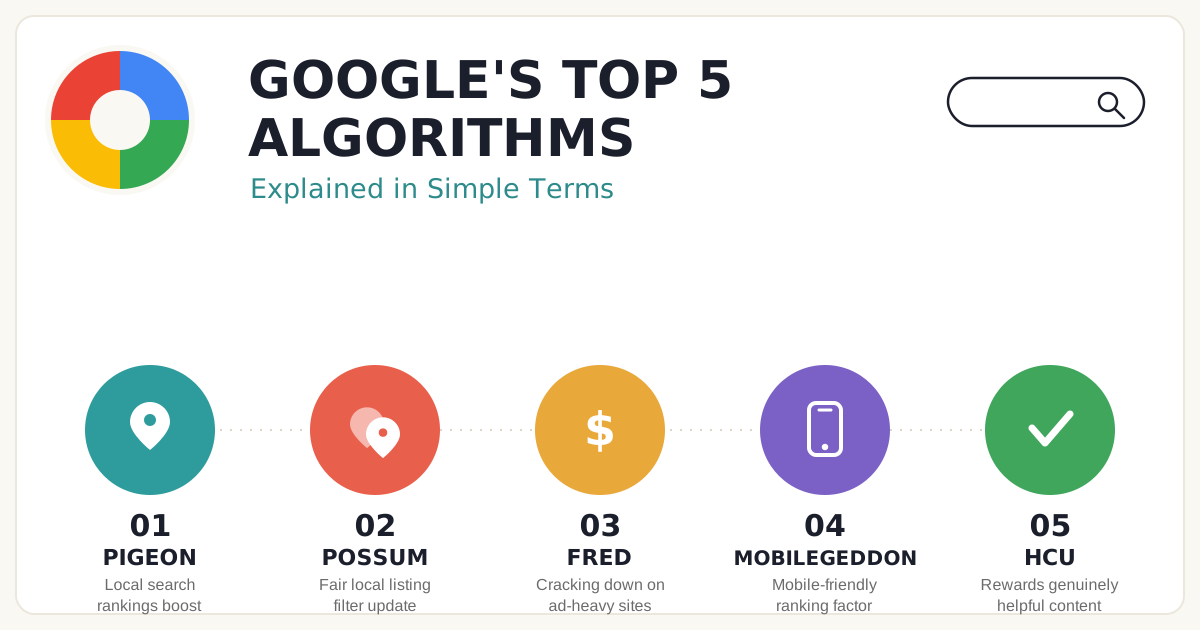
Some updates get all the attention (hello, Panda and Penguin), but there’s a quieter group of updates that shaped the SEO rules we all follow today, whether we realize it or not. In this post, we’re breaking down five of them: *Pigeon, Possum, Fred, Mobilegeddon, and the Helpful Content System (HCU)*. If you run a website, manage local business listings, or just want to understand why Google ranks things the way it does, this one’s for you.
1. Pigeon (2014): The Update That Made "Near Me" Searches Actually Work
Before Pigeon, Google’s local search results were a bit of a mess. You could search for “bakery near me” and get results that had little to do with your actual location or that ranked based on outdated signals rather than genuine location. Pigeon, rolled out in 2014, changed that by tying local search much more tightly to traditional web ranking signals like backlinks, on-page SEO, and content quality — while also sharpening how Google interpreted location and distance.
The result was a much closer relationship between Google Search and Google Maps. Suddenly, businesses with strong websites and consistent local information started outranking competitors who had been coasting on directory listings alone.
Why does this matter to you today? Because Pigeon laid the groundwork for everything we now call “local SEO”. If you run a physical business — a salon, a clinic, a restaurant, a repair shop — this update is the reason your Google Business Profile, your reviews, and your website’s local relevance all matter so much.
What actually helps after Pigeon:
– Keep your business name, address, and phone number (NAP) identical everywhere online — your website, Google Business Profile, directories, everything.
– Actively collect genuine customer reviews instead of ignoring that part of your profile.
– Write location-relevant content on your site (a page about your city or neighbourhood, for instance) instead of relying purely on generic service pages.
– Build local backlinks — get mentioned by local news sites, blogs, or community pages.
A pigeon’s core lesson hasn’t aged a day: if you want to show up when someone nearby searches for what you offer, your online presence needs to prove you’re relevant, active, and trustworthy — not just present.
2. Possum (2016): The Update That Gave Smaller Businesses a Fair Shot.
Two years after Pigeon, Google rolled out Possum — a much quieter update, but one that had a real impact on how local results were filtered. Before Possum, if two businesses shared a similar name, category, or address (think of multiple dentists in the same building, or several branches of one franchise), Google would often filter out all but one, showing users a narrower set of options.
Possum changed the filtering logic so that businesses located just outside a city’s official boundary — but still practically local — had a much better chance of appearing in local results. It also made the results more sensitive to the searcher’s literal location, meaning two people searching the same term from different neighborhoods might see slightly different local results.
This was a genuinely good thing for smaller and newer businesses. Before Possum, being physically located a few miles outside a city centre could quietly bury you in search results, even if you were the closest and most relevant option for a searcher. Possum levelled that playing field a bit.
What actually helps after Possum:
– Make sure your Google Business Profile category is accurate and specific — don’t just pick the broadest option.
– Don’t panic if your rankings vary depending on who’s searching and from where — that’s expected behaviour now, not a sign something’s broken.
– Diversify your backlink profile and reviews so you don’t look identical to a competing business at the same address.
– Keep your business information consistent, but also unique enough that Google doesn’t lump you in with similar listings nearby.
Possum’s real legacy is that local search stopped being a single, static leaderboard. It became something more personalized — and that meant more opportunities for businesses that weren’t sitting in the exact center of downtown.
3. Fred (2017): The Update That Punished Websites Built for Ads, Not People.
Fred didn’t have an official name for a while — the SEO community jokingly started calling every unnamed Google update “Fred”, and the name for this particular 2017 rollout just stuck. But don’t let the casual name fool you: Fred hit hard.
The update specifically targeted websites that prioritized advertising revenue over actually helping the person reading the page. Think thin blog posts stuffed with display ads, content that existed purely to get clicks rather than answer a question, and pages so cluttered with pop-ups and banners that the actual information was an afterthought. Many of these sites saw dramatic overnight traffic drops.
The message behind Fred was blunt: Google wants to reward pages that genuinely help searchers, not pages built primarily to generate ad impressions.
What actually helps after Fred:
– Write content that answers a real question thoroughly, not content padded out to justify more ad space.
– Keep ad placement reasonable — a few well-placed ads are fine, but a page where ads outnumber actual paragraphs is a red flag.
– Avoid clickbait titles that promise one thing and deliver something thinner.
– Focus on readability: clear headings, short paragraphs, and a logical flow that respects the reader’s time.
Fred is a good reminder that monetization and quality aren’t opposites — but when monetization becomes the entire point of a page, Google notices, and rankings suffer.
4. Mobilegeddon (2015): The Update That Made Mobile-Friendly Non-Negotiable.
Announced in April 2015, Mobilegeddon was Google’s way of telling website owners, in no uncertain terms, that mobile users mattered. The update made mobile-friendliness an official ranking factor for mobile search results — meaning sites that weren’t responsive, that required pinching and zooming, or that loaded painfully slowly on a phone started slipping down the mobile rankings.
At the time, plenty of businesses still treated their website as a desktop-first phone started as an afterthought. Mobilegeddon flipped that assumption on its head. It didn’t cause total chaos across every industry, but it sent a clear signal about where search was heading – and a few years later, Google’s move to mobile-first indexing (where Google primarily uses the mobile version of a site to determine rankings) made that direction permanent.
What actually helps after Mobilegeddon:
– Use responsive design so your site adapts cleanly to any screen size, rather than maintaining separate mobile and desktop versions.
– Test your page speed on mobile specifically — a fast desktop site can still be painfully slow on a phone.
– Make buttons, menus, and forms easy to tap without zooming in.
– Avoid intrusive pop-ups that cover the whole screen on mobile devices, since these can hurt both usability and rankings.
Mobilegeddon’s real legacy isn’t the update itself — it’s the mindset shift. Today, “is your site mobile-friendly?” isn’t even a question anymore; it’s assumed. That assumption exists because of this update.
5. Helpful Content System (HCU): The Update Built for the AI Era .
The Helpful Content System, first introduced in 2022 and folded into Google’s core ranking systems in 2023, represents a shift in how Google evaluates content at scale. Instead of targeting one specific issue like ads or mobile design, the Helpful Content System looks at whether content across an entire site is genuinely written for people — or whether it was mass-produced primarily to rank in search.
This update became especially relevant with the rise of AI-generated content. Sites that pumped out large volumes of generic, surface-level articles with little original insight, personal experience, or expertise started seeing real ranking damage — even on pages that weren’t individually “bad” by old SEO standards.
The Helpful Content System asks a simple but important question: if search engines didn’t exist, would this content still be useful to a real person? If the honest answer is no — if the page exists purely to capture a keyword — it’s exactly the kind of content this update was designed to identify.
What actually helps with the Helpful Content System:
– Write from genuine experience or expertise whenever possible — first-hand insight is hard to fake, and Google increasingly rewards it.
– Avoid publishing content purely to cover keywords with no real depth or unique perspective.
– Don’t outsource an entire content strategy to AI without human review, editing, and added value.
– Focus on satisfying the searcher’s actual intent completely, rather than splitting one topic into ten thin articles.
Of all five updates on this list, the Helpful Content System is the most future-facing. As AI tools make it easier than ever to produce content quickly, Google’s filtering for genuine usefulness is only going to get sharper, not softer.
Bringing It All Together.
Look at these five updates side by side, and a pattern becomes obvious. Pigeon and Possum reshaped local search around accuracy and fairness. Fred pushed back against content built purely for ad revenue. Mobilegeddon forced the web to take mobile users seriously. And the Helpful Content System is Google’s answer to a world where content can be generated faster than it can be genuinely useful.
Different targets, same underlying philosophy: Google keeps refining its search results to reward websites that respect the person on the other end of the search bar. You don’t need to obsess over every algorithm update as it happens. What you do need is a website that’s fast, honest, locally relevant if applicable, light on ad clutter, and packed with content that a real human actually needed to read.
Get that right, and you’re not just chasing algorithm updates — you’re already ahead of them.